Showing posts with label masculinity. Show all posts

Wednesday, 2 September 2015

6 Plastic Surgeries for Men That Prove Humanity Is Doomed

"Wow have I learnt something today.  My eyes are still watering from the thought of you guys having the scrotum reduction.
All joking aside my philosophy on cosmetic surgery is: if its what you want then go for it, but not without careful research.  Make a list of why you want to have surgery and how you think it will benefit you.  At the end of the day surgery can change the way you look but it cannot change how you feel about yourself, only you can do that".     - Susan Watts


fish2fishdating.com


6 Plastic Surgeries for Men That Prove Humanity Is Doomed


One area where women are far ahead of men is in the world of insecurity-driven plastic surgery. You just don't see men getting breast implants, and there are not yet reliable ways to do penis enlargements. But the industry is catching up, and now there's a whole array of cosmetic surgeries available to help men look more masculine. If you have thousands of dollars to spend and are completely oblivious to unintentional comedy, you too can get ...


#6. Mustache Surgery


fish2fishdating.com
Ryan McVay/Digital Vision/Getty Images


There's a certain kind of feeling a man gets when his upper lip looks perpetually dirty and/or like it was bitten by a werewolf. It's a mustache feeling. Cowboys, arctic explorers, porn stars, private investigators, and 1970s police detectives all wear mustaches totally free of irony -- it's a universal part of the cool dude's dress code. But tragically, not every man can grow one.


fish2fishdating.co.uk
Jupiterimages/Polka Dot/Getty Images


And some men just shouldn't.

So if you've been squeezing and grunting and pushing with all your might but can't manage to force out a Tom Selleck face badge, wipe that blood from your nostrils and/or eye sockets and get ready for some life-changing news -- you may be a prime candidate for mustache surgery. To the delight of hipsters and alopecic lumberjacks everywhere, this is totally a thing.


The Surgery:


Through a process called follicular unit extraction (which is a fancy way of saying "we pull your goddamned hair out"), dense groups of hair are harvested from other areas of the body and surgically crammed into your upper lip. It's essentially the same as scalp implants, only confined entirely to the space between your mouth and nose.


+fish2fishdating.com
Digital Vision./Digital Vision/Getty Images


"Without facial hair, I'm basically a dude in a ghost costume."


Mustache surgery is a growing trend in the Middle East, where thick mustaches are a sign of maturity, power, and prestige, sort of like a bushy "A+" you wear on your face. The way the mustache droops, curls, or bristles can even determine a man's political leanings, a system we feel should be incorporated into politics everywhere.


Photos.com/Photos.com/Getty Images

Finally, a less ridiculous alternative to powdered wigs.

The bad news is that the surgery will set you back around $7,000, and you need to have enough thick patches of hair growing elsewhere on your body to provide sufficient resources to create your Frankenstache. You're sure as hell not going to find someone willing to donate their mustache.


Wait, so can you have hair just implanted anywhere you want? Does that mean we can have ...


#5. Chest Hair Implant Surgery

fish2fishdating.co.uk
Jupiterimages/liquidlibrary/Getty Images
It sure does!


There is hope for those hairless men who have been cursed with the pink bird chest of Edward Norton, rather than the hirsute pectoral mane of Alec Baldwin.


fish2fishdating.co.uk
20th Century Fox


Hopefully they don't get their ass beaten nearly as often. 


The Surgery:


As we alluded to above, hair transplants are normally performed by harvesting strands from the back or chest and implanting them in the scalp to combat male pattern baldness. But, if you are in the unlikely situation of preferring the scalp-to-chest hair distribution ratio of George Costanza to that of a Brad Pitt, you can have the opposite procedure done and remove hair from your scalp to cultivate a thick meadow of chest fur. Doctors can surgically implant enough strands to elevate your torso beard to Baldwin levels of hairiness.


fish2fishdating.co.uk
 Hair Site
And if your ass is hairy enough, you can get the full Austin Powers chest hair.


That photo is from a hair restoration clinic in Miami that boasts more than 9,000 such procedures. The only downside? Unlike normal chest hair, the implant hair behaves like head hair -- that is, it continues to grow. Let that shit go for a year and you can have a luxurious ZZ Top beard dangling from your nipples.


Fish2FishDating.co.uk


#4. Voice-Deepening Surgery


fish2fish.com
Medioimages/Photodisc/Photodisc/Getty Images


Let's say you're a guy who runs into this situation every time you answer the phone:

YOU: Hello?

PERSON ON PHONE: Hello there, young lady! Can you put your dad on the phone? I'd like to speak to an adult man!

Yep, just because you now have the glorious chest hair of an Alec Baldwin doesn't mean you suddenly are rid of your high-pitched, dainty voice. You've tried to overcome this embarrassing physical flaw the good Lord saw fit to cripple you with from birth, but nothing seems to work. You do your best to sing along with Barry White albums, but it just ends up sounding like Barry has a pocket full of chorus mice. You try to mimic Darth Vader and Mufasa when you order a pizza, but it comes out like Verne Troyer being strangled to death by Herve Villechaize, and Papa John's is forced to call the police.


fish2fishdating.co.uk
New Line Cinema/MGM

Mini-Me and Nick-Nack. Just saved you a trip to Google.


It's a serious problem, according to the Texas Voice Center, the leading center for the diagnosis, treatment, and prevention of voice disorders: "In our society, a deep voice can convey strength and authority whereas a weak voice may suggest a lack of self-confidence." If you want to be taken seriously as a man, you're going to have to get voice-deepening surgery, because who are we to argue with the Texas goddamn Voice Center?


The Surgery:


The procedure is called fat injection thyroplasty, and it's meant for men with either weak, high-pitched voices that annoy the shit out of everyone they speak to or withered raspy voices that fill everyone in earshot with regret. During the surgery, fat is injected into the patient's vocal cords, bulking them up to create a deeper-sounding voice.


fish2fishdating.com
Jupiterimages/Photos.com/Getty Images

"No, that's too much James Earl Jones. I'm looking for more of a Vin Diesel feel."


The Texas Voice Center's website is noticeably unclear on where the donor fat comes from, but they do allow you to hear samples of men's voices taken before and after a successful thyroplasty. To be fair, there is a definite improvement in vocal quality, although the surgery doesn't really give you the smooth baritone of an R&B singer, and it apparently does nothing for one's reading skills. Also, we're not sure how you will explain the sudden change to friends ("Dude, why are you doing that movie trailer voice?") or your confused mother when you call her for the first time ("What have you done with my Bobby, you powerful, masculine fiend!?")


#3. Scrotum Reduction


fish2fishdating.com
Jupiterimages/Photos.com/Getty Images


Imagine you are a man on a date with a beautiful woman. She takes a seductively slow bite of her hot dog (because you're a man who appreciates both sexual innuendo and thrift), then leans across the table, spilling her ample cleavage like a glass of breast-colored water, and says, "Let's skip the ice cream and go back to your place."

You are appreciably excited, but suddenly you become gripped with a paralyzing uncertainty -- what will she think of your comically oversized scrotum? The deflated bat wings sagging below your baby injector are sure to be an instant turnoff, and with your confidence suddenly obliterated, you stand up from the table with your napkin still awkwardly tucked behind your belt buckle and wordlessly leave her in the restaurant, your massive nut sack fluttering in the wake of your shamed retreat like the topsail of a pirate galleon.

fish2fishdating.co.uk
Getty/John Carey


Your sad balls didn't just rob you of sex -- they robbed you of ice cream


Luckily, help is out there, and it exists in the form of cosmetic scrotum reduction surgery.


The Surgery:


Scrotum reduction surgery offers men the opportunity to tighten and raise their ball sacks, because the road to physical perfection is occasionally paved with hunks of ragged skin slashed from a droopy nutbag. The plastic surgeons who offer this service describe a variety of enticing justifications, including better-fitting underwear, unchafed thighs, and a certain je ne sais quoi of ball attractiveness.


fish2fishdating.com
photos.com


"But not too much. We don't want it looking like Ponda Baba's chin down there."


Jokes aside, Dr. Boris Volshteyn of Atlantic Surgical Associates angrily insists that this procedure is no laughing matter, dedicating a section of his website to addressing legitimate medical reasons to have a scrotum reduction. This is another way of saying that a board certified plastic surgeon wrote about the anguish of your mutant ball sack getting caught in bicycle seats and splashing down into fecal toilet water in broken English on the Internet to argue the validity of coin-purse-shrinking surgery.


fish2fishdating.com
Photodisc/Photodisc/Getty Images

Plus the extra money you now have to spend on a beanbag chair.


The procedure involves cutting away excess skin and repairing the muscle that connects the scrotum to the penis. Your testicles can be tucked and tightened in a simple two-hour outpatient surgery, although doctors warn that you will experience some discomfort for the next several days, possibly related to the fact that your genitals have just been dissected by a foreign national.


#2. Abdominal Etching


fish2fish.com
Comstock Images/Comstock/Getty Images


So let's say you work out from time to time, you manage to keep yourself from eating pizza four times a week, and you can still fit into most of the clothes you wore back in high school. All things considered, you're in pretty good shape. But are you in awesome shape? You long for glistening washboard abs, but those take extra time and energy. And what if you put in all that hard work only to end up with one of those weird stomach blocks like an old-timey circus strongman, or a set of weirdly mismatched bodybuilder abs instead of the perfect six-pack?


fish2fishdating.com
Photos.com


Mismatched or not, we'd still hit it.


Fortunately, guys can bypass all that hard work and uncertainty and just schedule an appointment to have a set of abs etched into their stomach, like an ice cube tray pressed into a Jell-O mold.


The Surgery:


Abdominal etching, also known as a "suction six-pack," is the precise extraction of lines of fat around the abdomen. However, it isn't a procedure for overweight men, merely devastatingly insecure ones. See, you can only undergo abdominal etching if you exercise regularly, but have 1 or 2 centimeters of "pinchable body fat" left to go. Rather than doing the amount of exercise required to slim down those 2 centimeters of belly fat, you can pay a plastic surgeon $5,000 to $7,000 to rip it out of your body with a vacuum. It's slightly less extreme than full-on liposuction and just a step or two above drawing hot dogs on your stomach with a magic marker.


Digital Vision./Digital Vision/Getty Images


Just remember to draw them upside down. Otherwise, you'll just look silly.


For some reason, ab etching is generally not recommended for bodybuilders or athletes, presumably because those are two classes of people who traditionally depend on muscles to actually perform feats of strength, rather than simply look good covered in hickory body paint and a tie-dyed grape holder.


But that's just the abs -- how do we get the rest of our body ripped without all of the, you know, effort? Well, there's ...


#1. Pec and Calf Implants

fish2fishdating.com
Thinkstock/Comstock/Getty Images


If you've never watched Predator and wished you could join in on the rampant and totally unironic flexing that populates the majority of that film, you are not being honest with yourself as a human being. If you've never watched Predator at all, get out.


Pixland/Pixland/Getty Image

"And take Jingle All the Way with you!"


Building that kind of muscle mass takes a lot of work, though -- at his bodybuilding prime, Arnold Schwarzenegger was doing 710-pound deadlifts and 440-pound bench presses, which is the type of training typically reserved for battling mythical creatures. Most of us aren't going to lift that amount of weight in an entire month, much less 30 times in an afternoon. Mercifully, there's another option -- surgically inserting muscle-shaped objects into your chest and calves to give the appearance of strength without any of its actual benefits.


The Surgery:


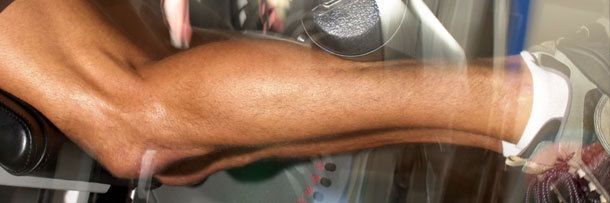
Whether you call it pec implants or chest enhancement, a male boob job is still accomplished by carving up your chest meat and shoving in the traditional pair of silicone bags. The end result creates the impression of rock-hard pectoral muscles sculpted from countless hours at the gym.


Pec Implants

An impression that lasts until someone asks you to pick up a bag of dog food.

And if you get the pectoral implants, you'll have to get calf implants as well to complete the ensemble or else you'll just look like a fucking lunatic. You might also need the leg implants as a counterweight for your giant fake muscle titties to prevent yourself from falling over in social situations.


fish2fishdating.com
Calf Implants


From zero to Adonis in two easy surgeries.


The calf implants are accomplished in pretty much the same way -- the doctor slices the back of your legs open and crams in a wad of silicone to balloon your skin out in an appropriately attractive manner. Again, we hasten to point out that, beyond making you look like a bulbous Frankenstein assembled from a drunken alien's Daytona Beach body harvest, these vanity muscle implants will not bestow you with any actual strength. Should you be trapped in an emergency situation and your fellow survivors call on you to lift a boulder off of some trapped kindergarten teacher, you are only going to disappoint them all and embarrass yourself, and they will likely conspire to have the shortest straw find its way into your hand when it comes time to figure out who's going to get eaten.

But goddammit, you'll look like a Greek god right to the end. And isn't that what matters?


View original article here

Previous articles:


Fish2FishDating.co.uk

Wednesday, 10 June 2015

Masculinity Is Killing Men: The Roots of Men and Trauma


Masculinity Is Killing Men: The Roots of Men and Trauma


“The three most destructive words that every man receives when he’s a boy is when he’s told to 'be a man,'” —Joe Ehrmann, coach and former NFL player

If we are honest with ourselves, we have long known that masculinity kills men, in ways both myriad and measurable. While social constructions of femininity demand that women be thin, beautiful, accommodating, and some unattainable balance of virginal and fuckable, social constructions of masculinity demand that men constantly prove and re-prove the very fact that they are, well, men.


Image result for masculinity

Both ideas are poisonous and potentially destructive, but statistically speaking, the number of addicted and afflicted men and their comparatively shorter lifespans proves masculinity is actually the more effective killer, getting the job done faster and in greater numbers. Masculinity’s death tolls are attributed to its more specific manifestations: alcoholism, workaholism and violence. Even when it does not literally kill, it causes a sort of spiritual death, leaving many men traumatized, dissociated and often unknowingly depressed. (These issues are heightened by race, class, sexuality and other marginalizing factors, but here let’s focus on early childhood and adolescent socialization overall.) To quote poet Elizabeth Barrett Browning, “tis not in death that men die most.” And for many men, the process begins long before manhood.

The emotionally damaging “masculinization” of boys starts even before boyhood, in infancy. Psychologist Terry Real, in his 1998 book I Don’t Want to Talk About It: Overcoming the Secret Legacy of Male Depression, highlights numerous studies which find that parents often unconsciously begin projecting a kind of innate “manliness”—and thus, a diminished need for comfort, protection and affection—onto baby boys as young as newborns. This, despite the fact that gendered behaviors are absent in babies; male infants actually behave in ways our society defines as “feminine.” As Real explains, “[l]ittle boys and little girls start off... equally emotional, expressive, and dependent, equally desirous of physical affection. At the youngest ages, both boys and girls are more like a stereotypical girl. If any differences exist, little boys are, in fact, slightly more sensitive and expressive than little girls. They cry more easily, seem more easily frustrated, appear more upset when a caregiver leaves the room.”

Yet both mothers and fathers imagine inherent sex-related differences between baby girls and boys. Even when researchers controlled for babies’ “weight, length, alertness, and strength,” parents overwhelmingly reported that baby girls were more delicate and “softer” than baby boys; they imagined baby boys to be bigger and generally “stronger.” When a group of 204 adults was shown video of the same baby crying and given differing information about the baby’s sex, they judged the “female” baby to be scared, while the “male” baby was described as “angry.”

Intuitively, these differences in perception create correlating differences in the kind of parental caregiving newborn boys receive. In the words of the researchers themselves, “it would seem reasonable to assume that a child who is thought to be afraid is held and cuddled more than a child who is thought to be angry.” That theory is bolstered by other studies Real cites, which consistently find that “from the moment of birth, boys are spoken to less than girls, comforted less, nurtured less.” To put it bluntly, we begin emotionally shortchanging boys right out of the gate, at the most vulnerable point in their lives. 

It’s a pattern that continues throughout childhood and into adolescence. Real cites a study that found both mothers and fathers emphasized “achievement and competition in their sons,” and taught them to “control their emotions”—another way of saying boys are tacitly instructed to ignore or downplay their emotional needs and wants. Similarly, parents of both sexes are more punitive toward their sons, presumably working under the assumption that boys “can take it.” Beverly I. Fagot, the late researcher and author of The Influence of Sex of Child on Parental Reactions to Toddler Children, found that parents gave positive reinforcement to all children when they exhibited “same-sex preferred” behaviors (as opposed to “cross-sex preferred”). Parents who said they “accepted sex equity” nonetheless offered more positive responses to little boys when they played with blocks, and offered negative feedback to girls when they engaged in sporty behavior. And while independent play—away from parents—and “independent accomplishments” were encouraged in boys, girls received more positive feedback when they asked for help. As a rule, these parents were unaware of the active role they played in socializing their children in accordance with gender norms. Fagot notes that all stated they treated sons and daughters the same, without regard to sex, a claim sharply contradicted by study findings.

Undeniably, these kinds of lessons impart deeply damaging messages to both girls and boys, and have lifelong and observable consequences. But whereas, as Terry Real says, “girls are allowed to maintain emotional expressiveness and cultivate connection,” boys are not only told they should suppress their emotions, but that their manliness essentially depends on them doing so. Despite its logic-empty premise, our society has fully bought into the notion that the relationship between maleness and masculinity is somehow incidental and precarious, and embraced the myth that “boys must be turned into men...that boys, unlike girls, must achieve masculinity.”

Little boys internalize this concept early; when I spoke to Real, he indicated that research suggests they begin to hide their feelings from as young as 3 to 5 years old. “It doesn't mean that they have fewer emotions. But they're already learning the game—that it's not a good idea to express them,” Real says. Boys, conventional wisdom holds, are made men not by merely aging into manhood, but through the crushing socialization just described. But Real points out what should be obvious about cisgender boys: “[they] do not need to be turned into males. They are males. Boys do not need to develop their masculinity.”

It is impossible to downplay the concurrent influence of images and messages about masculinity embedded in our media. TV shows and movies inform kids—and all of us, really—not so much about who men (and women) are, but who they should be. While much of the scholarship about gender depictions in media has come from feminists deconstructing the endless damaging representations of women, there’s been far less research specifically about media-perpetuated constructions of masculinity. But certainly, we all recognize the traits that are valued among men in film, television, videogames, comic books, and more: strength, valor, independence, the ability to provide and protect.

While depictions of men have grown more complicated, nuanced and human over time (we’re long past the days of “Father Knows Best” and “Superman” archetypes), certain “masculine” qualities remain valued over others. As Amanda D. Lotz writes in her 2014 book, Cable Guys: Television and Masculinities in the 21st Century, though depictions of men in media have become more diverse, “storytelling has nevertheless performed significant ideological work by consistently supporting...male characters it constructs as heroic or admirable, while denigrating others. So although television series may have displayed a range of men and masculinities, they also circumscribed a 'preferred' or 'best' masculinity through attributes that were consistently idealized.”

We are all familiar with these recurring characters. They are fearless action heroes; prostitute-fucking psychopaths in Grand Theft Auto; shlubby, housework-averse sitcom dads with inexplicably beautiful wives; bumbling stoner twentysomethings who still manage to “nail” the hot girl in the end; and still, the impenetrable Superman. Even sensitive, loveable everyguy Paul Rudd somehow "mans up" before the credits roll in his films. Here, it seems important to mention a National Coalition on Television Violence study which finds that on average, 18-year-old American males have already witnessed some 26,000 murders on television, “almost all of them committed by men.” Couple those numbers with violence in film and other media, and the numbers are likely astronomical.

The result of all this—the early denial of boy’s feelings, and our collective insistence that they follow suit—is that boys are effectively cut off from their feelings and emotions, their deepest and most vulnerable selves. Historian Stephanie Coontz has labeled this effect the “masculine mystique.” It leaves little boys, and later, men, emotionally disembodied, afraid to show weakness and often unable to fully access, recognize or cope with their feelings.

In his book, Why Men Can’t Feel, Marvin Allen states, “[T]hese messages encourage boys to be competitive, focus on external success, rely on their intellect, withstand physical pain, and repress their vulnerable emotions. When boys violate the code, it is not uncommon for them to be teased, shamed, or ridiculed.” The cliche about men not being in touch with their emotions says nothing about inherent markers of maleness. It instead identifies behavioral outcomes that have been rigorously taught, often by well-meaning parents and society at large. As Terry Real said when I spoke to him, this process of disconnecting boys from their “feminine” —or more accurately, “human”—emotional selves is deeply harmful. “Every step...is injurious,” says Real. “It's traumatic. It's traumatic to be forced to abdicate half of your own humanity.”

That trauma makes itself plain in the ways men attempt to sublimate feelings of emotional need and vulnerability. While women tend to internalize pain, men instead act it out, against themselves and others. As Real told me, women “blame themselves, they feel bad, they know they feel bad, they'd like to get out of it. Boys and men tend to externalize stress. We act it out and often don't see our part in it. It’s the opposite of self-blame; it's more like feeling like an angry victim.” The National Alliance on Mental Illness states that across race and ethnicity, women are twice as likely to experience depression as men. But Real believes men’s acting-out behaviors primarily serve to mask their depression, which goes largely unrecognized and undiagnosed.

Examples of these destructive behaviors range from the societally approved, such as workaholism, to the criminally punishable, such as drug addiction and violence. Men are twice as likely as women to suffer from rage disorders. According to the Centers for Disease Control, men are more likely to drink to excess than women, leading to “higher rates of alcohol-related deaths and hospitalizations.” (Possibly because men under the influence are also more likely to engage in other risky behaviors, such as “driv[ing] fast or without a safety belt.”) Boys are more likely to have used drugs by the age of 12 than girls, which leads to a higher likelihood of drug abuse in men than in women later in life. American men are more likely to kill (committing 90.5 percent of all murders) and be killed (comprising 76.8 percent of murder victims). This extends to themselves, according to studies: “males take their own lives at nearly four times the rate of females and comprise approximately 80 percent of all suicides.” (Interestingly, suicide attempts among women are estimated to be three to four times higher than that of their male counterparts.) And according to the Federal Bureau of Prisons, men make up more than 93 percent of prisoners.

The damaging effects of the aforementioned emotional severing even plays a role in the lifespan gender gap. As Terry Real explains:

"Men’s willingness to downplay weakness and pain is so great that it has been named as a factor in their shorter lifespan. The 10 years of difference in longevity between men and women turns out to have little to do with genes. Men die early because they do not take care of themselves. Men wait longer to acknowledge that they are sick, take longer to get help, and once they get treatment do not comply with it as well as women do."

Masculinity is both difficult to achieve and impossible to maintain, a fact that Real notes is evident in the phrase “fragile male ego.” Because men’s self-esteem often rests on so shaky a construct, the effort to preserve it can be all-consuming. Avoiding the shame that’s left when it is peeled away can drive some men to dangerous ends. This is not to absolve people of responsibility for their actions, but it does drive home the forces that underlie and inform behaviors we often attribute solely to individual issues, ignoring their root causes.

James Gilligan, former director of the Center for the Study of Violence at Harvard Medical School, has written numerous books on the subject of male violence and its source. In a 2013 interview with MenAlive, a men’s health blog, Gilligan spoke of his study findings, stating, “I have yet to see a serious act of violence that was not provoked by the experience of feeling shamed and humiliated, disrespected and ridiculed, and that did not represent the attempt to prevent or undo that ‘loss of face’—no matter how severe the punishment, even if it includes death.”

Too often, men who are suffering do so alone, believing that revealing their personal pain is tantamount to failing at their masculinity. “As a society, we have more respect for the walking wounded,” Terry Real writes, “those who deny their difficulties, than we have for those who 'let' their conditions 'get to them.'" And yet, the cost, both human and in real dollars, of not recognizing men’s trauma is far greater than attending to those wounds, or avoiding creating them in the first place. It’s critical that we begin taking more seriously what we do to little boys, how we do it, and the high emotional cost exacted by masculinity, which turns emotionally whole little boys into emotionally debilitated adult men.

Image result for masculinity

When masculinity is defined by absence, when it sits, as it does, on the absurd and fallacious idea that the only way to be a man is to not acknowledge a key part of yourself, the consequences are both vicious and soul crushing. The resulting displacement and dissociation leaves men yet more vulnerable, susceptible, and in need of crutches to help allay the pain created by our demands of manliness. As Terry Real writes, “A depressed woman’s internalization of pain weakens her and hampers her capacity for direct communication. A depressed man’s tendency to extrude pain...may render him psychologically dangerous.”

We have set an unfair and unachievable standard, and in trying to live up to it, many men are slowly killing themselves. We have to move far beyond our outdated ideas of masculinity, and get past our very ideas about what being a man is. We have to start seeing men as innately so, with no need to prove who they are, to themselves or anyone else.


Thursday, 27 February 2014

Is Equality in Marriage a Sexual Turn-Off?

Is Equality in Marriage a Sexual Turn-Off?

Psychotherapist Lori Gottlieb's NY Times Magazine article, "Does a More Equal Marriage Mean Less Sex?" shares sociological studies examining “Egalitarianism, Housework and Sexual Frequency in Marriage,” which posit that as couples become equal breadwinners and caregivers, the satisfaction they gain from sharing the chores is somehow dampening their desire for each other.  One study claims: “The less gender differentiation, the less sexual desire.” In other words, in an attempt to be gender-neutral, we may have become gender-neutered."  Is she right?

If a man helps me fold the sheets, does that negate his manhood?  Nonsense.


Fish2FishDating.co.uk


Here is the, ahem, thrust of Gottlieb's argument:
Marriage is hardly known for being an aphrodisiac, of course, but [this is] referring to a particularly modern state of marital affairs. Today, according to census data, in 64 percent of U.S. marriages with children under 18, both husband and wife work. There’s more gender-fluidity when it comes to who brings in the money, who does the laundry and dishes, who drives the car pool and braids the kids’ hair, even who owns the home. A vast majority of adults under 30 in this country say that this is a good thing, according to a Pew Research Center survey: They aspire to what’s known in the social sciences as an egalitarian marriage, meaning that both spouses work and take care of the house and that the relationship is built on equal power, shared interests and friendship. But the very qualities that lead to greater emotional satisfaction in peer marriages, as one sociologist calls them, may be having an unexpectedly negative impact on these couples’ sex lives.
The "Egalitarian" study found that "if men did all of what the researchers characterized as feminine chores like folding laundry, cooking or vacuuming — the kinds of things many women say they want their husbands to do — then couples had sex 1.5 fewer times per month than those with husbands who did what were considered masculine chores, like taking out the trash or fixing the car."


Hotel Bed

Image: Eric Chan via Flickr

Ok. So did a couple of guys who were frustrated with being asked to do the dishes get together and come up with this one?  And do we know the "1.5" number didn't have other mitigating factors attached to it?

As to what duties are an aphrodisiac, if one requires the performance of certain chores to turn you on, might I suggest gardening – all that digging around in the dirt with a trowel might be a little more primal…

So if a wife just sees her husband totin' that barge and liftin' that bale, he'll automatically become sexier?

He'll be sweatier, that's for sure.

Not every man with his shirt off looks like Ryan Reynolds splitting logs in the front yard.

Ms. Gottlieb admits that "correlations don’t establish causation, and especially when it comes to sex, there’s always a risk of reporting bias and selective sampling, not to mention the mood of a subject at the time of the survey."  i.e., "was the wife standing in front of garbage that had not been taken out."

The quoted study was published last year, but uses data compiled in the 1990s.  While attitudes have changed in 20 years, Gottlieb maintains her patients offered similar complaints, even though the sharing of child care and housework "makes a woman feel both closer to a man and happier with him."

Ms. Gottlieb shared that a female patient of hers wasn't turned on by her husband doing the ironing.
Ironing?  Hubba hubba!  I'm really turned on because it means I don’t have to do it.

If anyone wants to argue that ironing is woman's work, they ought to watch a military man iron his shirt.  Nobody irons or folds better than a man in uniform and I'd hardly argue any one of them are "feminized".

And by the way, our vacuum cleaner is heavy as hell so I appreciate it when my husband, who outweighs me by 90 pounds, schleps that thing around.  I find that mighty masculine.

Clearly, stereotypes are useless.  Isn't it also possible that in today's world, couples are working so hard to put the roof over their heads, take care of the kids, and/or an elderly parent, walk the dog, fix the roof, etc., that they're just bloody exhausted.  We have also become phone monkeys with entirely too much technology at our disposal that becomes a mindless balm and distraction from the day, encouraging ruts that are all too easy to get into.

To argue that a new division of labor in the home is causing men and women to somehow become homogenized and androgenous discounts the value of their happiness in the activities they share together.

Chopping salad in the kitchen with hubby is an excuse to flirt, razz one another and canoodle.  A lot more enticing a proposition than his sitting in the barc-a-lounger shouting 'bring me a beer, honey' while I stand in the kitchen cooking by myself – after we've both worked all day.  That's most definitely not an aphrodisiac.

Shared chores means the crap gets done faster, leaving a couple more time to go out and play.  Or stay in.  Besides which, unless a woman is preparing dinner in Victoria's Secret underoos, I doubt her doing classically "feminine" chores will drive her husband to distraction either, so I dispute that men and women maintaining stereotyped roles in the home is going to affect how they view each other sexually.

This study also indicates that men prioritize the erotic and women do not.  Say it with me:  Stereotype.   There are many factors, including perhaps a lack of communication or habits formed over a long union which are just as likely to cause the kind of bland erotic life on which Gottlieb reports.

Ms. Gottlieb also states the following:
Is the trade-off of egalitarian marriage necessarily less sexual heat? It’s possible that the sexual scripts we currently follow will evolve along with our marital arrangements so that sameness becomes sexy. Regardless, more people marrying today are choosing egalitarian setups for the many other benefits they offer. If every sexual era is unhappy in its own way, it may be that we will begin to think of the challenges of egalitarian marriages less as drawbacks and more like, well, life, with its inherent limitations on how exciting any particular aspect can be.
I would also disagree that being equal partners in marriage means you are turning into mirror images of each other.  I don't see drawbacks, but much greater fulfillment for both.  Equal partners experience less stress knowing the weight is carried on both their shoulders.  Equality does not equal "sameness."  In a comfortable, healthy relationship, partners are allowed flexible roles.  In any marriage, one person may be stronger at a certain task, though one partner pinch hitting for the other when needed is much appreciated.  No two people can maintain a successful union if they are each trapped into wearing the same hat all the time.


She also notes that "American couples who share breadwinning and household duties are less likely to divorce."  If some couples still have typical ideas of masculinity and femininity, cannot there be a differentiation between the romantic and the practical?

The studies Ms. Gottlieb cites argue that much is lost if couples are not able to maintain a "me Tarzan, you Jane" posture.  I would argue that the decision to offer each other that permission (or any fantasy you can name) is still plenty available.  Whether or not their relationship will support it has nothing to do with who is doing the laundry.


*************************

Other previous articles:


  • How to Be Not Terrible to Your Significant Other’s...
  • 5 signs you’re marrying the WRONG person
  • Ending Up "Just Friends"
  • Do You Get Pain During Intercourse? (dyspareunia)
  • Big testicles, fellas? She'll cheat on you. Tiny b...